Visualising Long Covid @CS4Health Conference (Zurich)

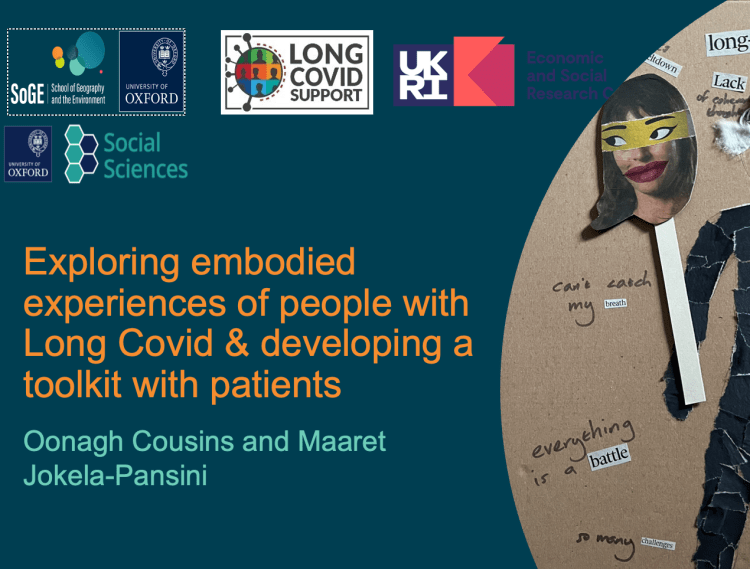
Visualising Long Covid poster
From the left: Beth Greenhough, Chantal Britt & Maaret Jokela-Pansini

The Health Working Group of the European Citizen Science Association (ECSA) organised its second conference on Citizen Science for Health at the ETH Zurich on 6-7 November 2025. It was a fantastic opportunity for our team to present our work in an environment where those with lived experience of illness, their carers, and families are put at the centre of research as active participants. It was also the first time that our UK team from the University of Oxford and our Swiss partners from Long Covid Switzerland could jointly present the results of the body mapping workshops conducted in both countries with people with Long Covid.

Blog #2 Understanding the economic impacts of Long Covid: A qualitative study

By Amelia Zabika and Tom Crothers

October 2025

In July 2025 we started a summer internship in the School of Geography and the Environment at the University of Oxford through the UNIQ+ program. Our project focused on trying to better understand the economic impacts of Long Covid. Long Covid is a term used to describe a range of post-acute, long-term health effects that follow SARS-CoV-2 infection. Research to date has mainly focused on large-scale macroeconomic impacts, with estimates suggesting that Long COVID contributed at least 8.6% of the rise in economic inactivity due to ill health last year. Through collaboration with the charity Long Covid Support this project sought to complement this work by generating qualitative insights into what these changes meant for people’s everyday lives.

Currently, around 2 million people in the UK self-report Long Covid symptoms. Many of these people struggle with work, with some having to leave their jobs and becoming increasingly dependent on others (especially family) for support. They face financial struggles due both to loss of earnings and the increasing costs which often accompany chronic illness. They also often feel unsupported by the state, and by friends, colleagues and the wider public.
Between July and August 2025, we conducted in-depth, qualitative interviews with 9 people living with Long Covid and two representatives from advocacy organisations who worked to support them and others like them. Reading across these interviews we drew out four main themes: impacts on work, the challenges of applying for benefits, the additional costs of living with chronic illness and housing insecurity.

Work
‘I had been teaching about five or six years and I was in a new school. I’d moved the September before I caught COVID. And yeah, absolutely loved it. Like a lifelong dream. I miss it terribly.’ (Interview LCAP02)

‘My career that I was retraining for, this councillor career, that’s completely taken away. I feel robbed. I feel robbed by long COVID of my ability to work.’ (LCAP04)

For most people Long Covid significantly changed their work life. All those we spoke to expressed a strong desire to continue working, but many also felt they lacked support from their employer. While participants haven’t mentioned outright discrimination, some felt as after they have requested reasonable adjustments their workplace became more hostile to them. Often their employers and co-workers failed to understand the dynamic nature of Long Covid, which is characterised not by a slow road to full recovery (as is often assumed when people are offered adjustments such as a phased return to work) but by period of feeling better followed by period (ranging from days to months) when symptoms worsen. This lack of understanding was present in the public and private sector. Things were even more complicated for participants who were self-employed and who had limited flexibility to adjust their working hours and roles while sustaining their business.

Benefits
It’s hell applying for PIP. It’s extremely tiring. It took me a couple of weeks to fill in the PIP application form. It required me to, you know, real terrible levels of fatigue and it’s quite humiliating. The level of detail that you must submit, you must submit like doctor’s letters. The level of detail in terms of like things like your ability to wash and look after yourself and stuff.’ (LCAP04)

With earnings falling, employment options exhausted and savings running out, many of our participants had turned to the benefit system in the UK for support. While some managed to successfully navigate the system and received welcome support, for many the application process was challenging, practically, physically and emotionally. Practically, the processes and forms involved were not a good fit for the dynamic nature of Long Covid symptoms, and applicant who had their call with a case worker on one of their good days found it difficult to convey the severity of the challenges they faced. Physically, many found the process of completing the application was hampered by their illness, describing the process as ‘draining’, ‘horrific’ or stating that ‘it’s hell’. Most of the participants required family support and assistance while completing the process. Some were further impacted by what felt like a hostile, judgemental and disbelieving attitude expressed by some case workers. Others noted the intrusive and at times humiliating nature of the information they were forced to disclose.

Additional spending
‘I spent my life savings on medical care and experimentation. I spent every penny I had; spent on private medical care because the NHS couldn’t do anything; on different supplements, different drugs […] I’ve done a lot and I’m still spending. I still spend like £300/£400 a month on supplements just in case they make a difference.’ (Interviewee LCAP01)

One aspect that really came across in the interviews that has not been so prominent in previous research is the range of new costs people with Long Covid find themselves facing. These include increased spending on health and medical care. Finding limited support and treatment options through the NHS, many people with Long Covid have turned to the private sector. Others experiment with supplements and other alternative forms of medicine in the pursuit of even marginal improvements in symptoms. Another key unanticipated cost is transport for those whose Long Covid restricts their mobility. Participants reported how buses did not bring them close enough to their homes, leading to them being forced to take taxis for shorter journeys. Longer journeys that require trains were for some too expensive or required significant planning (which in itself could be exhausting). Collectively these transport costs have prevented people from seeing their family and friends, further increasing their social isolation.

Financial strain and housing insecurity
Our mortgage is due for renewal in two years because we’ve got a five-year deal and we’re not sure we’ll be able to get another mortgage on this because my salary has dropped so much. The multiplier just isn’t there. (LCAP03)

A combination of reduced income and increased costs, alongside general increases in the cost of living across the UK, left many participants facing significant financial hardship, having to budget harder to manage these costs. Many were also concerned about future financial security. While some participants who owned their own homes felt insulated against this to some extent, others, especially those with large mortgages or rent payments, shared uncertainty around housing. One participant had had to sell their house while others had moved back in with family members. This not only highlights the fragility of the economic situation of people living with Long Covid, but also their reliance on informal support in the shape of their family and partners.

Collectively, this research presents the day-to-day financial impacts of having Long Covid in more depth. It highlights the general lack of awareness of Long Covid – within the National Health System, the Department of Work and Pensions and amongst employers, the significant financial costs and burdens it creates for many of those affected and the profound impacts this has had on our participants’ lives and dreams.

Body mapping Long Covid: interview in The Guardian

People with post-infectious diseases sometimes struggle to communicate the debilitating impact of their conditions. But a new technique can help them explain visually

Post-infectious diseases such as long Covid and ME/CFS (myalgic encephalomyelitis/chronic fatigue syndrome) pose a puzzle to the medical establishment. Patients report debilitating symptoms such as extreme fatigue, shortness of breath or muscle pain, but often show normal results on routine medical checkups. And many sufferers do not look ill, leading some to question the severity of their disease. In the absence of diagnostic tools or an understanding of the pathophysiological processes, many sufferers find it difficult to share their experiences. They lack a verbal language that expresses the true impact of the illness.

Now, researchers from Oxford University are using the technique of “body mapping” to help patients better communicate the physical, cognitive and emotional dimensions of their illness to family, friends and health professionals.

Read the full article here

Supporting an NHS that’s there for people with ME and Long Covid: From #ThereForME to #ThereWithYou

#ThereForME is a campaign founded by Karen and Emma, two carers for partners with very severe ME/Long Covid. The campaign is supported by 23 organisations and smaller initiatives supporting people with ME/Long Covid. #ThereForME is calling for an NHS that’s there for people with ME and Long Covid.

You can read our blog post for the campaign here

Discussing Long Covid research and body mapping with Medical Anthropology students

This week we were invited to talk about body mapping and Long Covid research with graduate students of Medical Anthropology at the School of Anthropology and Museum Ethnography, University of Oxford. The students were curious to know about the concrete application of body mapping in public health settings, the ways body mapping may be used in health-related research more broadly, and how body maps may be analysed together with other research data. Sharing research outcomes in undergraduate and graduate teaching is an important part of researchers’ work and we were excited to have the opportunity to discuss so many thought-provoking questions with students!

Our research team at the Royal Geographical Society’s Annual Meeting in London, August 2024

From the left: Jo Dainow, Beth Greenhough, Maaret Jokela-Pansini and Oonagh Cousins

We presented the Body mapping toolkit for Long Covid patients at the Annual Meeting of the Royal Geographical Society in London. The session, titled ‘Body mapping in geographical research: Embodied and collaborative ways of mapping bodies, communities, and environments’ was organised by Thembi Luckett (University of Newcastle) and Maaret Jokela-Pansini (University of Oxford) and included fascinating presentations about applying body mapping in research from urban planning and environmental resistance to reflecting on body images and feelings of shame. The session highlighted collaborative ways of doing research with communities and discussed concrete outputs from such collaborations.

Oonagh Cousins interview in The Times

‘Long Covid and ME have devastating impacts on individuals, families and society more widely. NHS figures — which are massively outdated — indicate that ME affects at least 250,000 people across the UK. However, it is estimated that upwards of 1.3 million people are living with ME or ME-like symptoms following a Covid-19 infection’.

To read the whole interview, click here